Ecotas - Composting service
UX Strategy · AI-Native Design

Scope:
AI-Accelerated UX Strategy
Year:
2026
OVERVIEW
Running a short series of workshops with a tiny Japanese startup, using generative AI to turn strategy conversations into tangible interface concepts within hours instead of weeks, to help their home-composting service become clearer and more attractive to customers.
The Mission
Work directly with a small 2-3 person team in Tokyo to help them grow their eco-friendly composting service.
The Product
A household compost box that seals with a zipper. Users fill it, mail the soil back to Ecotas, and Ecotas distributes it to regional farms to grow food.
The Goal
Figure out how to make the service appealing and scale their early customer base up from just ~10 active users.

PROBLEMS
Low Sales
The service idea was interesting, but they were barely selling any boxes.
Cultural Barrier
Home composting is unusual in Japanese residential areas, so people had natural hesitation around things like smell and hygiene.
Lack of Education
There was no clear explanation or guide showing users why they should participate, or how composting actually helps the environment.
Transactional Focus
The early business model focused mostly on the logistics of selling the physical box, rather than designing a good long-term experience for the person using it.
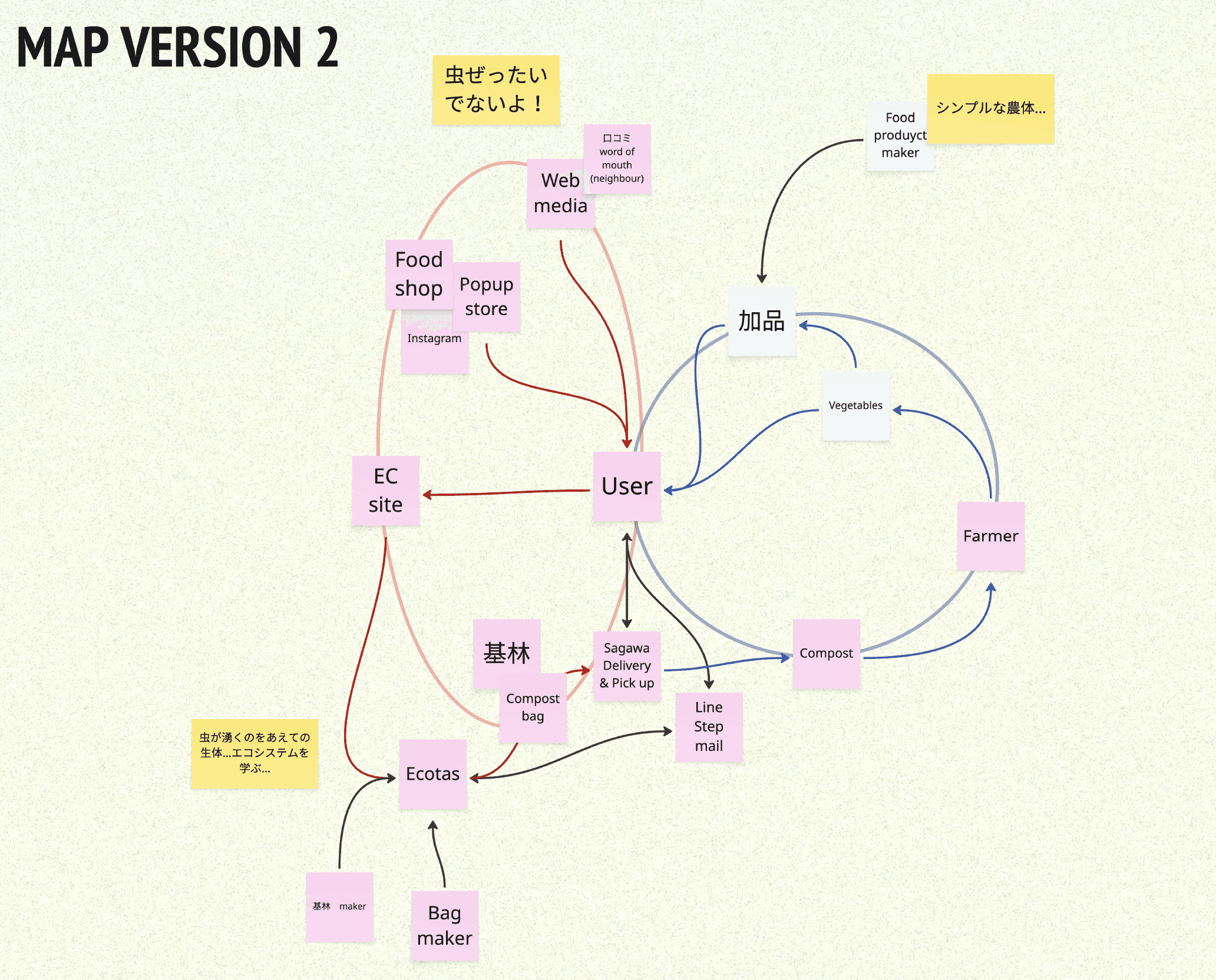
We mapped out key observations about Ecotas' current business structure to highlight potential issues with their marketing and product strategy.

MY ROLE
I co-created two strategy workshops with my team and the company's founder, Nakano-san. Since home composting is far more common in European households, I brought that cultural context into the room to help figure out how to make the habit feel normal rather than messy for users in Japan. My main individual contribution was turning the workshop's raw ideas into something tangible in real time: I used generative AI tools like Figma Make to draft rough app layouts on the spot, so the founder had a concrete direction to react to immediately instead of waiting on a follow-up deck.
DIRECTION
We focused on changing how Ecotas connects with its customers, shifting them from selling a one-off physical box toward a community lifestyle loop, whether that took shape as an app, a website, or real-life events.
SOLUTIONS
Visualizing the Strategy
This is what turned an abstract strategy conversation into something the founder could actually react to. Instead of presenting text-heavy slide decks, I used Figma Make to generate rough interface concepts live during the workshop, translating each idea into a visual within minutes of it being said. This directly addressed the Transactional Focus problem: seeing a possible app, website, or community feature made the shift from "selling a box" to "designing an experience" concrete rather than theoretical. I was careful to frame these as disposable sketches, not commitments to build an app specifically. The goal was speed of thinking, not a finished product.

Three Strategic Hypotheses
This tackled the Cultural Barrier and Lack of Education problems directly. I built the final presentation around three ideas to test what would actually motivate users to stick with the service:
Contribution & Feedback: users want to see the real-world impact of their effort. The concept tracks exactly where their mailed soil goes, with progress logs and milestone rewards like discounts on produce grown from their own composted soil.
Learning & Confidence: to overcome unfamiliarity, we proposed friendly step-by-step guides teaching users how to handle soil safely, grow things at home, and understand how their choices reduce waste.
Togetherness & Community: composting can feel lonely and messy, so we added concepts for community forums and local events organized by Ecotas, giving users a sense of shared purpose.
OUTCOMES
Pivoting the business model
The workshops helped the team see their own business differently. We recommended moving away from one-off hardware sales toward a continuous membership or subscription experience.
Renewed direction
The founder left with a concrete list of ideas to explore. Seeing their limited resources mapped against a realistic, community-driven plan gave the team back momentum for their product roadmap.

LEARNINGS
AI as a Thinking Tool, Not Just a Production Tool
When working with tiny, non-technical teams, polished pixels don't matter. Rough, immediate drafts are the fastest way to help a founder understand structural changes and make quick project decisions.
Design for reality
A 2-3 person company can't manage a complex, heavy internal product system. As a designer, you have to find ways to let the community handle the engagement, building the digital tool to automate the connection rather than creating more manual work for the startup.
Purpose Before Product
If an app or website asks users to adopt a strange, unfamiliar habit, they won't download it just for features. They need to connect with the company's long-term environmental purpose before they'll bring a compost box into their kitchen. That means focus on the "why" before the "what."